What Happened?
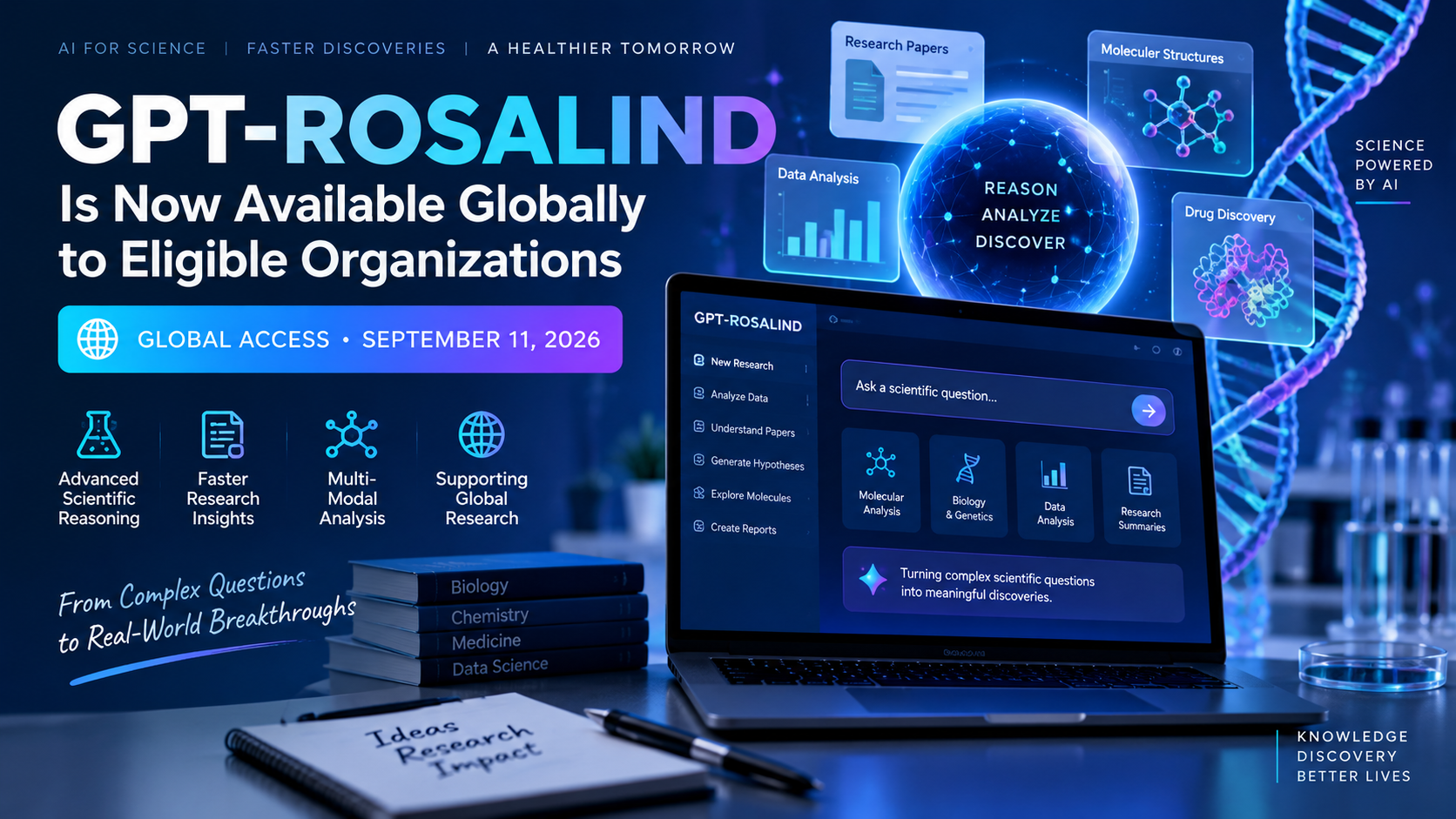
OpenAI announced an important update to GPT-Rosalind on September 11, 2026. The specialized model for life-sciences research is moving out of research preview and is now available globally to eligible organizations through OpenAI’s trusted-access program.
GPT-Rosalind is designed specifically for scientific work involving areas such as:
- Biology
- Drug discovery
- Medicinal chemistry
- Genomics
OpenAI says the model combines advanced reasoning and tool-use capabilities with a deeper understanding of life-sciences workflows.
What Can It Help With?
The model is intended for complex research tasks rather than ordinary chatbot conversations.
Potential applications include:
- Understanding scientific literature
- Analysing biological and chemical information
- Supporting drug-discovery research
- Working with quantitative biology problems
- Assisting with research and experimental workflows
OpenAI reports performance improvements across biology, medicinal chemistry, quantitative biology, and wet-lab troubleshooting tasks in its evaluations.
Why Does This Matter?
This development shows how AI is becoming increasingly specialized. Instead of using one general-purpose system for every task, organizations can use models designed for specific professional fields.
For computer and technology education, this is an important concept to understand. AI specialization means combining artificial intelligence with domain knowledge.
For example:
A general AI system may explain the concept of DNA, while a specialized scientific model can be designed to work more deeply with biological research questions.
Pricing and Access
OpenAI says published pricing for GPT-Rosalind will take effect on October 5, 2026.
Access is currently available to eligible organizations through the trusted-access structure.
Why Students and Professionals Should Care
The development is especially relevant to students and professionals exploring:
- Artificial Intelligence
- Data Science
- Scientific Computing
- Machine Learning
- Life-Sciences Research
The broader takeaway is that the future of AI is not only about creating more powerful general-purpose models. It is also about developing specialized AI systems that understand the workflows, terminology, and challenges of specific industries and professional fields.