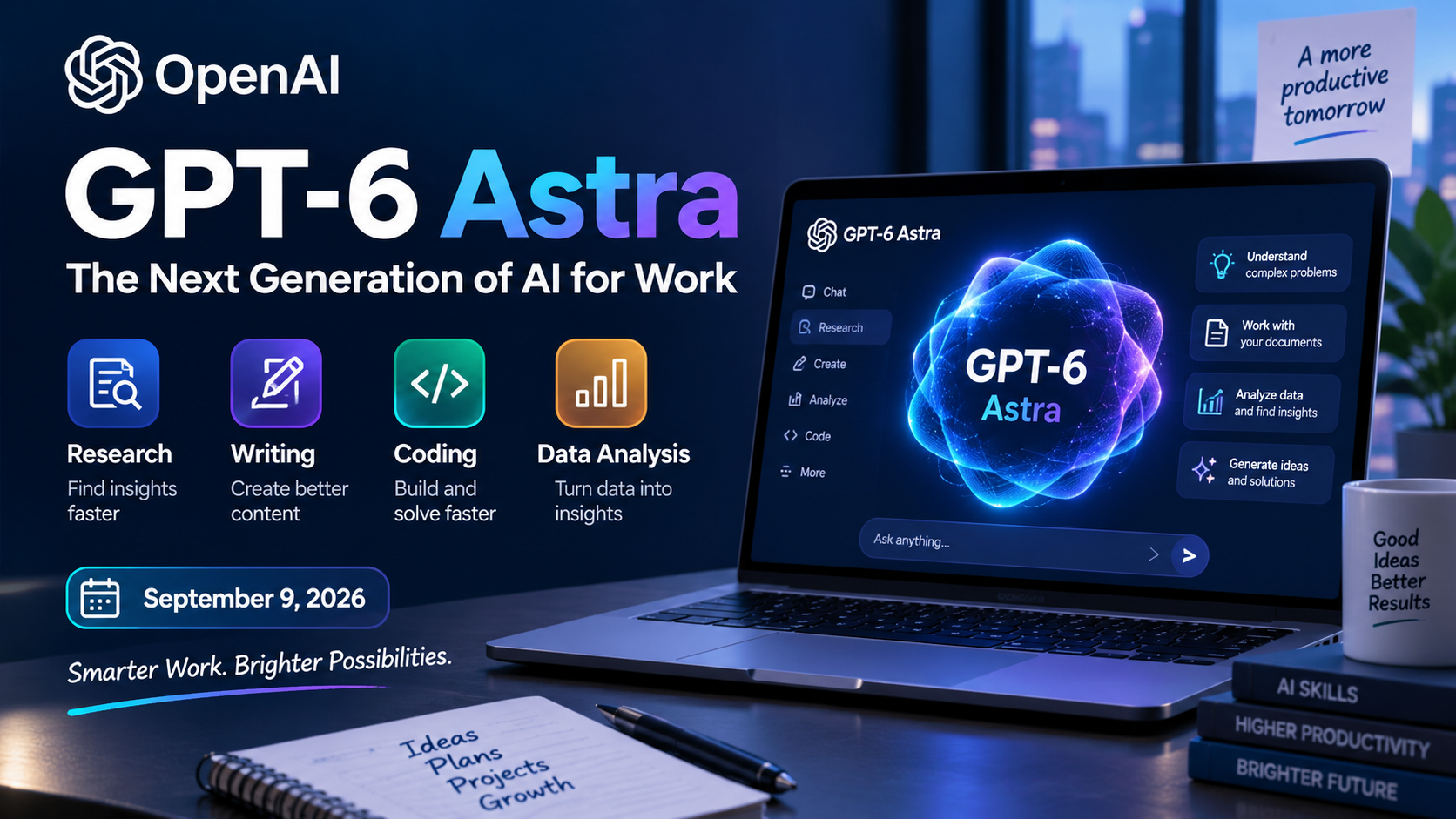
OpenAI announced GPT-6 Astra on September 9, 2026, describing it as its most capable model for professional work. Astra is available in ChatGPT Work, Codex and the API and is designed to handle tasks involving computer use, browsing, software engineering, cybersecurity, science and professional documents.
One of the biggest changes is that Astra is designed to work with the same applications people already use. According to OpenAI, it can interact with applications even when those applications do not provide an API. This could make AI useful for workflows that previously required custom integrations.
For office professionals, that could mean using AI to work with documents, spreadsheets, presentations and business applications. OpenAI says early users have already applied Astra to tasks such as checking financial statements, optimizing systems and creating presentation decks.
For developers, the model is also positioned as a stronger software-engineering assistant. OpenAI reports a 57.9% result on Terminal-Bench 4.0, compared with 37.3% for GPT-5.6 Sol in the cited evaluation.
Another important area is AI safety and control. OpenAI says Astra has additional controls for enterprise users, including restrictions on approved websites and applications, upload and download controls, confirmation policies and automated review of potentially unsafe tool calls.
This matters for computer education because AI skills are moving beyond simple chatbot questions. Students and professionals increasingly need to understand how AI can interact with software, analyse information, create documents and support multi-step workflows.
The important lesson is not simply “learn the newest AI model.” It is to learn how to combine AI with real digital skills—Excel, Word, PowerPoint, programming, data analysis and research—while checking the results.
AI can save time, but understanding the work remains essential.