A new education-technology report is raising an important question: Are students actually learning, or are they simply becoming better at using educational technology?
Education Week reported on September 4, 2026, on a new report from the American Psychological Association examining digital learning tools. The report emphasizes that engagement with a technology product should not automatically be treated as evidence of learning.
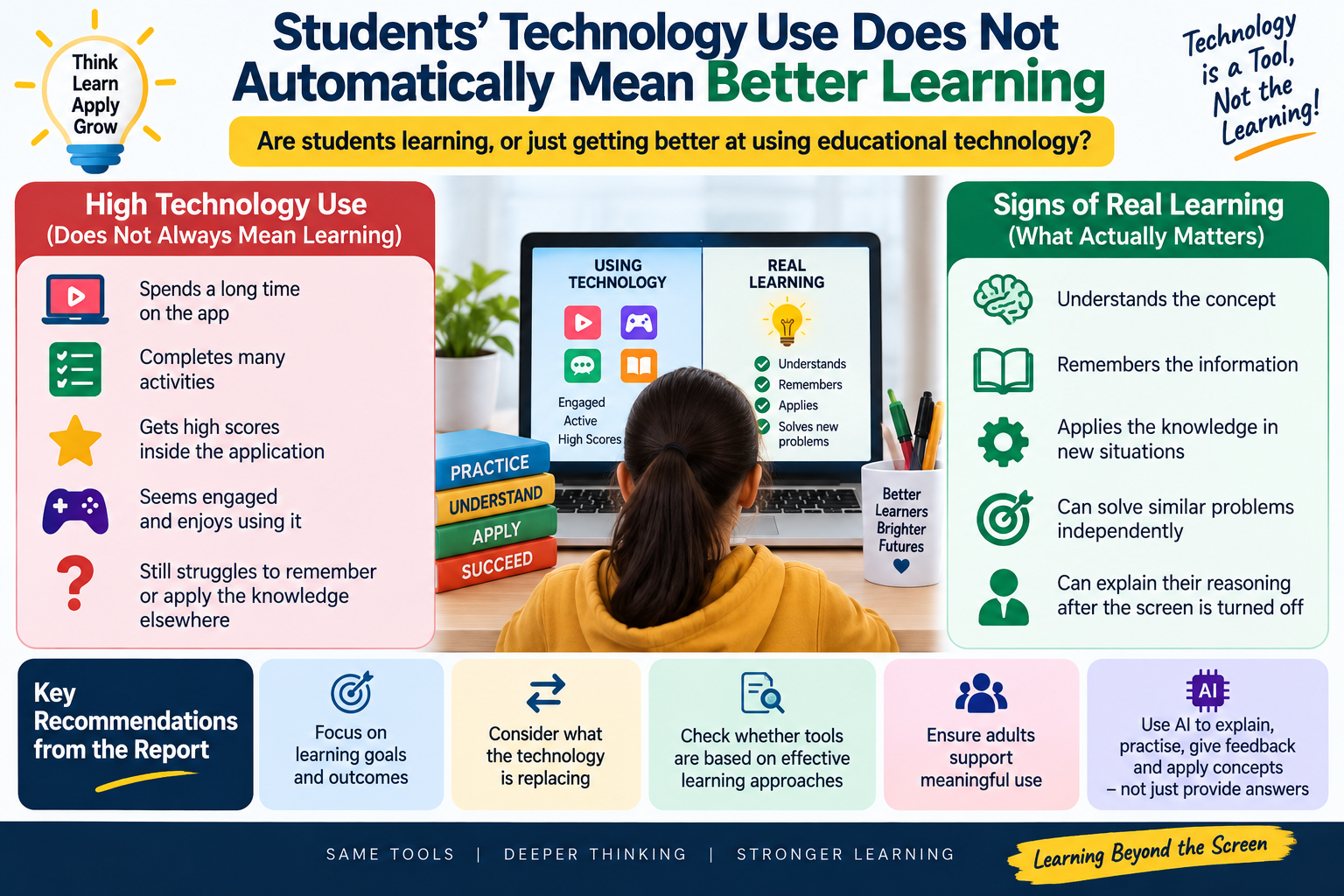
The distinction is important. A student may spend a long time using an educational application, complete many activities and receive high scores inside that application, yet still struggle to remember or apply the same knowledge elsewhere.
The report recommends focusing on actual learning goals and outcomes rather than simply measuring engagement or enjoyment. It also encourages educators to consider what the technology is replacing, whether the tools are based on effective learning approaches and how adults support their use.
This idea is especially relevant as AI becomes part of educational software. AI can be useful when it helps students retrieve knowledge, explain their reasoning, practise skills, receive feedback or apply concepts in new situations.
A simple example is mathematics. Asking an AI tool to provide the final answer may save time, but asking it to explain the method and then solving a similar problem independently can support deeper learning.
Technology should therefore be viewed as a learning tool, not the learning itself.
For teachers and parents, one useful question is: “What can the student do after the screen is turned off?” If the student can explain the concept, solve a new problem and apply the skill independently, the technology has served a meaningful educational purpose.