Artificial intelligence in education is entering a new phase as school systems debate how students should use generative AI.
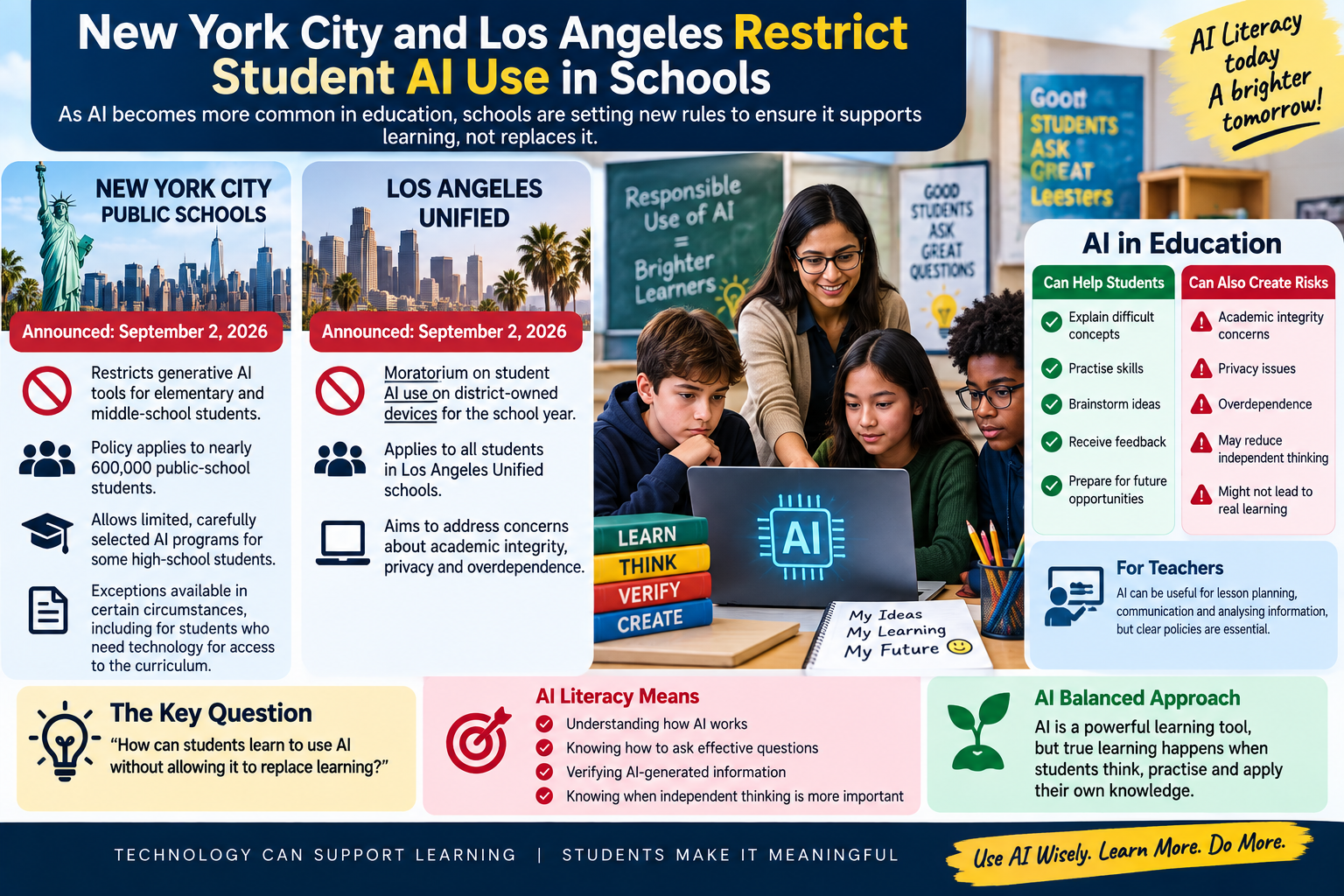
On September 2, 2026, New York City Public Schools announced restrictions on student-facing generative AI tools for elementary and middle-school students. Los Angeles Unified also announced a moratorium on student AI use on district-owned devices for the school year.
New York City’s policy applies to a school system serving nearly 600,000 public-school students. It restricts AI-powered learning tools for younger students while allowing limited, carefully selected AI programs for some high-school students. Exceptions are available in certain circumstances, including for students who need technology for access to the curriculum.
The debate is not simply about whether AI is good or bad. Schools are trying to answer a more difficult question: How can students learn to use AI without allowing it to replace learning?
AI can help students explain difficult concepts, practise skills, brainstorm ideas and receive feedback. At the same time, unrestricted use can create concerns about academic integrity, privacy, overdependence and whether students are actually developing their own skills.
For teachers, AI can also be useful for lesson planning, communication and analysing information, but schools need clear policies explaining acceptable use.
The New York decision is particularly interesting because high-school students will still receive some opportunities to work with carefully selected AI tools. School officials say older students need preparation for a world where AI is already part of everyday life.
For computer education, this creates an important lesson: AI literacy should include both capability and responsibility.
Students should learn how AI works, how to ask effective questions, how to verify AI-generated information and when independent thinking is more important than automation.